In ancient Greece, the Doric Columns, one of the primary orders of Greek architecture, the Artemesium Bronze, a famous Greek sculpture symbolising art and athleticism and from the city of Artemesium on the Ionian cost (Turkey today)., and Corinthian helmets were all constitutional innovations and artifacts that could assist in shaping Greece into a developing civilization while also leading an example for the next forthcoming ones.

The first, Doric Columns are a style of column built by ancient Greek architects to hold up sections of buildings. They were invented for the use of supporting ceilings without the use of solid walls which therefore could provide more space and natural lighting to buildings. Out of the several orders developed for the designs of Greek architecture, Doric is one of the earliest. It was a stout, thick and heavy shaft that would hold up most heavy weight. The entire Greek civilization was affected, and then later the Romans as they had adopted idea of the column. And thus, the changes were everlasting, as it has had an enduring impact on even Western architecture today and is seen now in basements as pillars and shown in modern interior design.
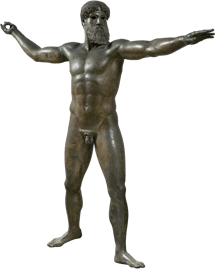
The Artemesium Bronze is a 2m tall sculpture that is made of bronze and is meant to represent either Zeus of Poseidon. It was found at the bottom of the sea off cape Artemesium in north Euboea. Many were affected by the artifact simply because sculptures in Greek history were a representation of the Gods and their religion. The goal of many sculptures was to show the “perfect athletic build”, to motivate their own athletes. Its purpose served as a depiction of their religious values. They were likely worshipped at an earlier time by the society.
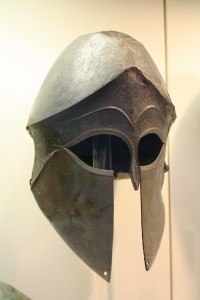
The next artifact, the Corinthian Helmet, was generally made of bronze, used primarily for combat by Greek warriors. Its name was given by the city in which it was originated in, which was Corinth. The amount of effort and decor it was constructed with would often depict the social standing of the wearer of the helmet. People were affected by the Corinthian helmet because its main purpose provided safety from combat. But it also occupied a piece of Greek culture as well, as young men were often given a helmet as a rite of passage into manhood, and when not being worn it was displayed in homes. Other civilizations were also affected as they had also adopted the style of the Corinthian helmet and gradually made it their own.
Bibliography:
Craven, Jackie. “All About the Doric Column.” ThoughtCo. Accessed October 16, 2018. https://www.thoughtco.com/what-is-a-doric-column-177508.
Cartwright, Mark. “Column.” Ancient History Encyclopedia. October 15, 2018. Accessed October 16, 2018. https://www.ancient.eu/column/.
NATIONAL ARCHAEOLOGICAL MUSEUM OF ATHENS – OFFICIAL SITE. Accessed October 16, 2018. http://www.namuseum.gr/collections/sculpture/classical/classic02-en.html.
“Corinthian Helmet 7th-6th Century BC.” Collections & Research | National Museum of Ireland. Accessed October 16, 2018. https://www.museum.ie/The-Collections/Documentation-Discoveries/February-2014/Corinthian-Helmet-7th-6th-Century-BC.
“Doric Columns, Remarkable and Famous Buildings, Characteristics of Doric.” Ancient Greece Facts.com. Accessed October 16, 2018. http://www.ancientgreecefacts.com/doric-columns/.
The Hoplite Battle Experience. Accessed October 16, 2018. https://sites.psu.edu/thehopliteexperience/the-corinthian-helmet/.

 Ancient Greece