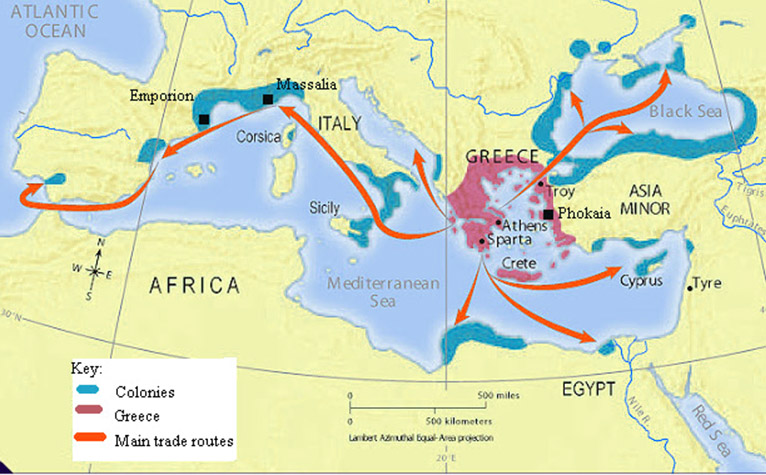
Ancient Greece was a powerful civilization that lasted from 800 BC until 146 BC, at the beginning of Roman conquest[1]. While it is regarded as the end of the civilization, the developed culture, policies, and philosophy of ancient Greece managed to persevere throughout the centuries to make a lasting legacy that was widely imitated and still learned from today. Three artifacts that had left a prominent influence on our present culture from ancient Greece is democracy, which they had invented. Also, a new and original approach to philosophy that has changed the way we think forever, lastly and well known, is their architecture.

[2]
In our modern era, especially in the Western civilization, an exceedingly important political aspect is the system of democracy, which can be traced back to Athens[3]. Democracy is now known the ideal government in the Western world. The name and concept was originally conceived by the ancient Greeks, who began the practice around 507 BC[4]. At the time the idea was unpopular and criticized mostly by those of the upper class in Athens. The system then was short lived and around 460 BC when Pericles began to rule government[5], modifications came into the system which could be better described as an aristocracy, resulted in democracy not enduring long.
The continuity and change of ancient Greek democracy is that the premise today still stands on majority vote, but obviously there has been a change in how voting is done since then. When democracy was first invented it was originally made of three separate institutions, but all had the same basis of majority vote[6].
The historical significance of democracy is that it gave us a better understanding of the thought process of the Greeks, giving prominence to the views and influences they had amongst and against each other. Although we typically generalize ancient civilizations social and thinking skills as primitive, and often speculate to be mostly inferior to our own, we can clearly see how developed the Greeks were with structure and critical decision making. The cause of this historical legacy is there is a voice for every person and idea. We value the ancient Greeks invention of democracy because it left an impact that has changed the way of living for many different countries over many different centuries. Democracies today are proven to have a more egalitarian distribution of wealth, giving a sense of fairness and equality while uprooting caste systems, keeping the population free of famine, and growing faster in the economic sphere[7].

[8]
The second artifact that ancient Greece has left to make a lasting impression on humankind is their contemporary approach to philosophy. It started with proposing questions that had an imaginative but thought provoking focus, based more on life in general that would help shape our minds and be passed on throughout the centuries. The historical significance of Greek philosophy set a basis and would be a contribution, especially in Western civilization, to better guide us to observe and interpret our world.
This newfound approach to philosophy started primarily with Socrates who changed the academic view of philosophy, by making it a study of life itself[9]. He wrote down nothing but inadvertently passed down his knowledge to several others through oral teachings, and then these individuals proceeded to cultivate this knowledge into schools and institutions[10]. Socrates himself had contrived a contrast from the then popular philosophical concerns of the physical world and deviated instead to inquiries on moral and psychological focal points[11]. Though, his powerful thoughts and ideas, original as they were, weren’t appreciated by all and he was thus accused for refusing to recognize the gods recognized by the state and corrupting the youth[12]. The penalty would be death. He lived on through his students, mainly Plato who grew to be the founder of the Academy, which was the first institution of higher learning in the Western world. This resulted in a lasting continuity and philosophy would also expand even further to influence political theory. Another philosopher that made a lasting impact was Polybius, who was responsible for developing a useful system in telegraphy which was called the Polybius square. It consisted of letters being signaled via the numerical system. This would result and contribute to the idea of cryptography[13]. The early comprehension and intelligence this civilization held has made a difference for us today and shows us how influential the cognition of those before us really was.
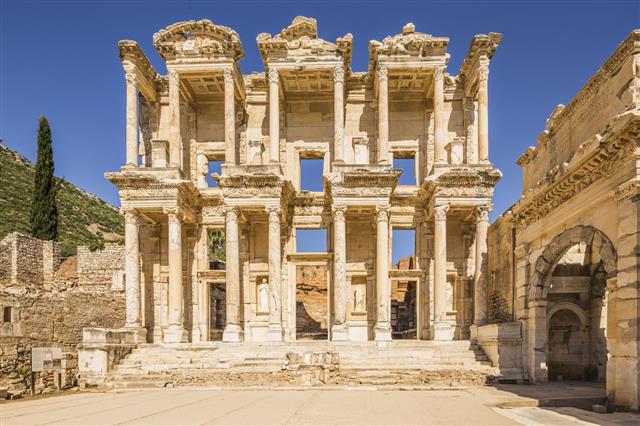
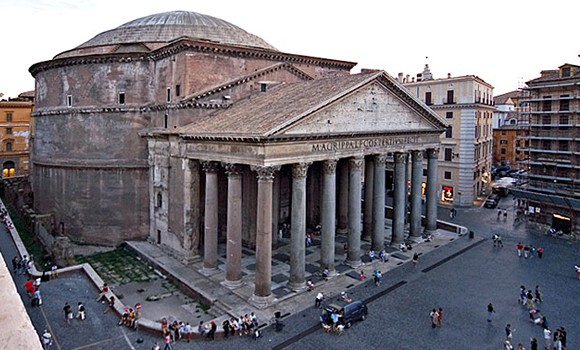
Lastly, another legacy of this ancient civilization is their architecture. All around the world there are pieces of ancient Greek architecture, seen on some of the most important buildings and museums in the modern world. Known most famously for their columns and temples, constructed of sturdy stone and marble, this style of building would be an influential and strong foundation for modern architecture. The Greeks had built their temples and buildings in three different orders. Some examples of famous buildings that duplicate the ancient Greeks is the Lincoln Memorial, the Prado Museum, and Cambridge University.[15] Doric columns and colonnades are also well-known as a borrowed aesthetic in many personal homes. The primary change in these structures is the function. What was less for decoration and more for support, the original concerns were chiefly set on the proportion, perspective and harmony. Advanced innovations of optical refinements in ancient temples would be made invisible to the naked eye, to make the structure perfectly straight and sound[16]. This allows us to see the historical perspective of the importance that this ancient civilization held in precision, inventing formulas for architecture from as early as the sixth century[17], for the purpose an impeccable perfection and durability in their buildings and living quarters.
The most distinct element of the lasting impact of ancient Greek architecture is from antiquity, Greek buildings were replicated by the Romans, thus to be re-discovered in the Renaissance which would put ancient Greece at the center of a 18th century Neo-Classical movement in Western Europe[18], which is what made it a permanent legacy.
In closure, though this advanced civilization perished in 146 BC, the innovations left behind have passed through the millennia’s. We see clearly from their thought processes the impact of philosophy and democracy, giving us a voice in politics, and how these advancements led us to our modern day thinking. This insight would go beyond, and seen physically, where the perfection and accuracy of architecture of this ancient civilization was displayed on temples and buildings. Though ancient Greece is over, their civilization has proven to be a lasting one with such rich and beneficial ideas to pass on.
[1] “Ancient Greece for Kids.” Ducksters Educational Site. Accessed March 14, 2019. https://www.ducksters.com/history/ancient_greece.php.
[2] “Athenian Orator Addressing the Council. Illustration from The Illustrated History of the World (Ward Lock, C 1880).” Digital image. Accessed March 14, 2019. https://www.lookandlearn.com/history-images/M070625/Athenian-Orator-addressing-the-Council.
[3] “Greeks Invented Democracy.” ICal. March 04, 2016. Accessed March 14, 2019. https://www.greekboston.com/culture/inventions/democracy/.
[4] Ibid.
[5] Ibid.
[6] Ibid.
[7] “The Consequences of Democracy.” Waylaid Dialectic. March 24, 2014. Accessed March 14, 2019. https://waylaiddialectic.wordpress.com/2010/07/29/the-consequences-of-democracy/.
[8] Digital image. Socrates: The Right Man for Our Age? May 1, 2015. Accessed March 14, 2019. https://www.athensinsider.com/socrates-the-right-man-for-our-age/.
[9] Violatti, Cristian. “Greek Philosophy.” Ancient History Encyclopedia. March 13, 2019. Accessed March 14, 2019. https://www.ancient.eu/Greek_Philosophy/.
[10] Ibid.
[11] “Tailor-Made Travel Experiences.” English. Accessed March 14, 2019. https://athensinsiders.com/the-top-10-ancient-greek-philosophers/.
[12] Ibid.
[13] “Polybius Square.” Crypto Corner. Accessed March 14, 2019. https://crypto.interactive-maths.com/polybius-square.html.
[14] Digital image. Everything You Want to Know About Ancient Greek Architecture. March 19, 2018. Accessed March 14, 2019. https://historyplex.com/ancient-greek-architecture.
[15] “The Influence of Ancient Greek Architecture.” Owlcation. Accessed March 14, 2019. https://owlcation.com/humanities/The-Influence-of-Ancient-Greek-Architecture.
[16] “Reading Greek Temples.” Study Guide: Reading Greek Temples. Accessed March 14, 2019. https://www.reed.edu/classics/studyguides/temples/parthenon-refinements.html.
[17] Metmuseum.org. Accessed March 14, 2019. https://www.metmuseum.org/toah/hd/grarc/hd_grarc.htm.
[18] Study.com. Accessed March 14, 2019. https://study.com/academy/lesson/neoclassical-greek-architecture.html.







 Ancient Greece