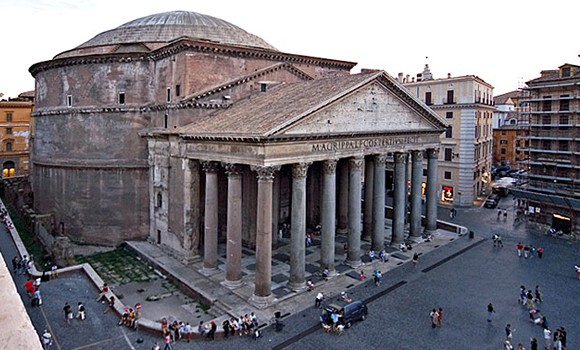
The decline of ancient Greece was a result of many factors over several years. It wasn’t a direct and immediate response; rather, the decline was something that progressed gradually over time. There are three artifacts I have chosen to represent the fall of ancient Greek civilization. The most distinct artifact that I have chosen is the hasta, which translates into a spear.[1] The reasoning other than the obvious intended war purposes is to depict the battle of Corinth. The second artifact chosen was the Pantheon Roman temple, highlighting the cultural assimilation of Greece and Rome. And lastly, I have chosen a coin with Alexander the Great on it, to define his death, the aftermath, and the tenacious impact it left on ancient Greece as an individual civilization.
The first object, being the hasta, symbolizes the battle of Corinth. This battle was in 146 BC where the state of Corinth was sacked,[2] and marked the downfall of ancient Greece independence and the onset of Roman occupation.
The hasta translates from Latin to ‘thrusting spear’, which was used to jab and thrust instead of the alternative throwing, which is usually associated with spears. This is what was used chiefly by the Romans in the battle of Corinth. The Romans largely outnumbered the Greece with over 23,000 infantry,[3] it gave little defense in battle for the Greeks. After this successful conquest, women and children were sold into slavery while the men were executed.[4] The destruction of Corinth was a pivotal moment endured in ancient Greek history, as this artifact used contributed a negative change that resulted in the rapid advancement for the decline of Greek civilization. As a turning point in history, the Greeks lost their identity and Roman domination flourished. There is continuity in the artifact of the hasta and the Latin words still exists today in other cultures. Though not in use anymore, the spear is still a famous and well known artifact presented in museums.

The second artifact I chose in order and relevance of the Roman conquest of Greece was the Pantheon Roman temple. During and before Roman domination, Greece still held a predominant influence on culture. Although the Romans spoke Latin as opposed to traditional Greek,[5] their civilization was the culture engine of the Roman Empire. Even when no longer in control, Greece carried onto a cultural assimilation. The Pantheon temple was dedicated to the Greek goddess Athena,[6] a Greek god. The building itself was based off the Doric columns,[7] the first order of columns of Greek architecture. This illustrated the slow and negative change, also a marking point in history where the ancient Greek life would be not only forgotten but also replicated. The worship of Greek gods to the Romans was a form of cultural appropriation, they renamed several of the Gods but the premise and values of them still remained authentic. The Pantheon temple was built several hundred years before the battle of Corinth, and work for the structure began in 447 BC.[8] The shift and modification of traditional Greek religion, though at a much earlier time, initiated not only the decay of the original culture but a positive continuity for the Greeks. It is a pleasant reminder that although they would lose much of their original life, it wasn’t completely buried underneath the Roman conquest.
The last artifact for the decline of Greek civilization is a coin of Alexander the Great on it. Though not in order with Roman conquest, the death of Alexander the great would start a dividing period in ancient Greek history and prove to be their downfall. Politically speaking, this could be considered the beginning of the end for Greece. Since Greece had no specific country or nations, Alexander the Great was known mostly for his uniting of Greek city states and his many victories conquering surrounding lands including Persia.[9] Greece was at its peak in his command and Alexander the Great formed a vast empire. With his death in 323 BC,[10] commenced the start of what is distinguished
as the Hellenistic period. The Hellenistic period did not end until 31 BC,[11] when the last Hellenistic Greek kingdom was conquered by Rome. In this period, Alexander the Great branched out his power between various generals and his family. Once this happened, the city states split, resulting in a huge gap in power. This weakened Greece and constituted much internal conflict. The dissension between city states would keep Greece largely unprotected from external political conflict, thus leaving them vulnerable to Rome. The coin of Alexander the Great that I chose to represent is an important featured artifact because it presents the huge effect he held over the civilization. The coin of Alexander the Great simultaneously embodies a negative change and a positive continuity for ancient Greece. Even 250 years later, the empire still continued to use coins with his name on it. [12]This is a major turning point in history and following the death of Alexander the Great, ancient Greece civilization would turn to a direction that soon afterwards led to its deterioration.

Bibliography:
[1] Smith, William. “Hasta.” Arch of Augustus, 21 Apr. 2018, Accessed January 15, 2019. penelope.uchicago.edu/Thayer/E/Roman/Texts/secondary/SMIGRA*/Hasta.html.
[2] “Event #35: Destruction of Corinth,” A Timeline Graph of Events, March 22, 2016, , accessed January 15, 2019, https://cof.quantumfuturegroup.org/events/35.
[3] GreekBoston, “What to Know About the Battle of Corinth,” What to Know About the Battle of Corinth, August 14, 2017, , accessed January 15, 2019, https://www.greekboston.com/culture/ancient-history/battle-of-corinth/.
[4] Ibid.
[5] Katherine McDonald, “The Language of the Roman Empire,” History Today, November 11, 2017, , accessed January 15, 2019, https://www.historytoday.com/katherine-mcdonald/language-roman-empire.
[6] The Editors of Encyclopaedia Britannica, “Parthenon,” Encyclopædia Britannica, November 01, 2018, , accessed January 15, 2019, https://www.britannica.com/topic/Parthenon.
[7] Thomas Sakoulas, “The Parthenon,” History of Minoan Crete, , accessed January 15, 2019, https://www.ancient-greece.org/architecture/parthenon.html.
[8] Ibid
[9] Joshua J. Mark, “Alexander the Great,” Ancient History Encyclopedia, January 13, 2019, , accessed January 15, 2019, https://www.ancient.eu/Alexander_the_Great/.
[10] Ibid
[11] History.com Editors, “Hellenistic Greece,” History.com, February 04, 2010, , accessed January 15, 2019, https://www.history.com/topics/ancient-history/hellenistic-greece.
[12] Andrew McIntyre, “Ancient,Rare,Coins,Alexander,the,Great,Coins,Rare, Seleucid,Coins,Roman,Coins,Greek,Coins,Emperor,Augustus,Emperor,Tiberius,Emperor,Trajan,Emperor,Hadrian,” Coins of Time – Ancient Coin Rings of the Roman Empire, , accessed January 15, 2019, http://www.coinsoftime.com/Articles/Coins_of_Alexander_the_Great.html.
[13] Roman Weapons. Accessed January 22, 2019. http://www.ancientmilitary.com/roman-weapons.htm. PDF. 2010.
[14]“Rome’s Pantheon.” Rome Segway Tours 10 Facts about the Pantheon Comments. Accessed January 22, 2019. https://romeonsegway.com/10-facts-about-the-pantheon/.
[15]“The Coinage of Alexander The Great.” History Of Macedonia. Accessed January 22, 2019. http://history-of-macedonia.com/2012/06/03/the-coinage-of-alexander-the-great/.

 Ancient Greece